In 2014, two high school sophomores (two teenagers) looked around their world and saw a profound disconnect. While the headlines were increasingly filled with the complexities of race in America, the actual conversations happening at classrooms, dinner tables, and friend groups were often nonexistent. Guo and Vulchi started CHOOSE because they realized that even when we weren’t talking about race, our lives were being dictated by it.
From the zip codes we lived in to the people we called friends, racial division wasn’t just a historical concept—it was a contemporary architect of our daily reality.
Read more: How Two Teenagers Created a Textbook for Racial Literacy
To understand why CHOOSE exists, one must look at the data that defines the American social landscape. One of the most jarring statistics that fueled our early work remains a cornerstone of our mission: three out of four white Americans do not have a single friend of color. When social networks are this homogenous, the “empathy gap” widens. Research from the Public Religion Research Institute (PRRI) reinforces this, showing that the average white American’s social network is 91% white. This lack of proximity leads to a lack of understanding, which in turn feeds systemic inequity.
Read More: These Women Are Changing The World Through Books — And In Ways You Wouldn’t Expect
We often describe our work as a bridge for the “heart-mind gap.” * The Heart: Driven by personal narratives, lived experiences, and the emotional weight of identity.
- The Mind: Rooted in statistics, historical context, and systemic analysis.
Without the “mind,” stories can feel like isolated incidents. Without the “heart,” statistics feel cold and unactionable. Our first major project, The Classroom Index, was designed to fuse these two, pairing raw human stories with the systemic context needed to understand why those stories were happening.
What began as a local project in Princeton, New Jersey, quickly evolved into a national listening tour. We recognized that to provide a toolkit for every American, we needed to hear from every corner of the country.
Read More: High School Students Write Racial Literacy Textbook
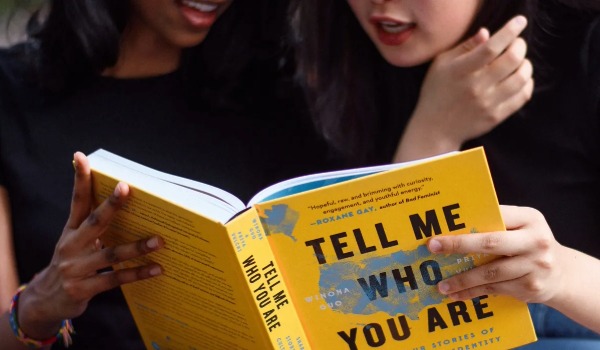
Guo and Vulchi traveled to all 50 states to collect stories about race, culture, and intersectionality. These weren’t just interviews; they were deep dives into the American psyche. We met people in rural diners, urban community centers, and suburban living rooms. These conversations culminated in our book, “Tell Me Who You Are.”
Racial literacy isn’t just about knowing history; it’s a 21st-century life skill that allows us to navigate complex social interactions. Here are the types of scenarios CHOOSE addresses through our curriculum:
- The “Colorblind” Classroom: An educator avoids discussing race to “treat everyone the same” but ignores the fact that students of color are disciplined at significantly higher rates for the same infractions as their white peers (Source: U.S. Department of Education Office for Civil Rights).
- The Professional Microaggression: A workplace where a person of color is frequently told they are “so articulate,” a compliment that carries the historical baggage of low expectations.
- The Neighborhood Divide: Understanding why a certain neighborhood is 90% white is not just “preference,” but often the result of historical redlining and GI Bill exclusions.
Read More: 2 NJ High School Students Create Racial Literacy Text to Help Schools and Teens Learn to Talk About Race
Evaluation: Why Racial Literacy Matters Now
As a 501(c)(3) non-profit, our success isn’t measured in book sales—though 100% of our proceeds go back into the mission—but in the integration of racial literacy into K-12 education.
| Metric | Impact Area | Goal |
| Empathy Building | Personal | Moving beyond “3 out of 4” toward diverse, meaningful social circles. |
| Curriculum Reform | Institutional | Making racial and intersectional literacy a graduation requirement. |
| Systemic Awareness | Cognitive | Equipping students to identify redlining, bias, and inequity in real-time. |
Imagine a world where young people grow up proud of their backgrounds but deeply invested in the communities they share. This isn’t just about “tolerance”; it’s about co-creating a shared American culture that is equitable, loving, and just.
Our mission is clear: to provide every American with the tools for effective conversations about race. We believe that if you can’t talk about it, you can’t fix it.
Tell Me Who You Are is more than a book; it’s an essential guide to bridging our racially divided world. It has been described as “exactly what our country needs right now” because it refuses to look away from the complexity of our identities.
Join the Movement
The journey that started in 2014 continues today. Whether you are an educator looking for tools to support your students or a citizen looking to bridge the gaps in your own community, there is a place for you in this student-led movement.
We are still getting to work. Will you join us?